


Bangka Belitung and Lampung are Indonesia’s two largest pepper provinces. In 2020 the country had 52,192 hectares of pepper producing 32,520 tonnes; Lampung alone held 45,834 hectares, second only to Bangka Belitung.12 Our landing page says the ground beneath that reputation is eroding for four reasons that compound each other. This piece sets out what the research actually shows for each one, and where the evidence is thinner than we would like.
1. Pepper became harder to sustain
What we claim: falling prices have made pepper harder to live on, and in Bangka Belitung some pepper land has gone to tin mining, oil palm and other crops.
What the evidence shows:
- A third of the land and half the output gone in five years. Figures cited by the Bangka Belitung office of the Directorate General of Treasury show that between 2019 and 2024 the province’s pepper output fell from 33,458 to 16,717 tonnes, planted area from 29,325 to 19,909 hectares, and pepper-growing households from 62,672 to 41,916. The office put the lost economic value at about Rp 2.69 trillion a year, and named disease, high production costs, conversion to tin mining and oil palm, unstable prices and weak bargaining power as the causes.3
- Prices swing hard and have fallen from their peak. The Directorate General of Estate Crops reported farm-gate prices of Rp 80,000–90,000 per kg in August 2022, against Rp 150,000 per kg in 2015–2016.4 A 2019 study in Jebus, West Bangka, recorded white pepper at Rp 46,000–55,000 per kg and found farmers saying the price no longer covered fertiliser and upkeep.5
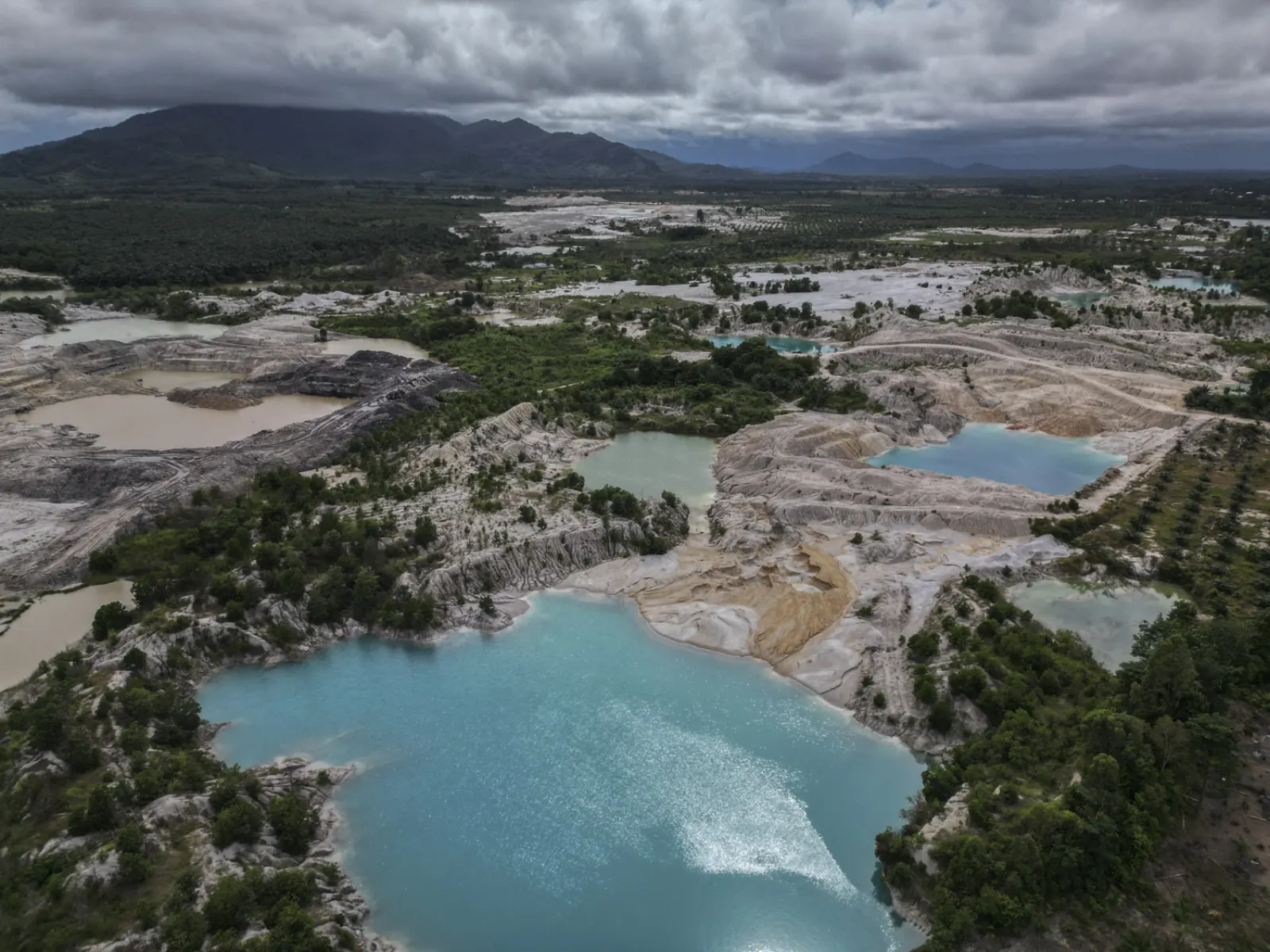
- Tin has been taking the land. A 2023 paper on Muntok White Pepper’s geographical indication traces how, as pepper fell from Rp 90,000 to Rp 12,000 per kg between 1999 and 2003 while tin held firm, households turned to mining; it reports up to 70% of the local population depending on (often unlicensed) tin mining, pepper plantations being converted to mine sites, and 275,000 hectares of land in the province left in critical condition.6 The authors warn that, unchecked, this threatens the reputation of the GI itself.
- Oil palm is now part of the pepper landscape. The 2024 IPB study on Bangka found pepper grown alongside oil palm, and recorded more yellow disease there than in pepper not intercropped with palm.7
Caveat: we did not find a recent, province-wide figure for how many hectares of pepper have become oil palm specifically. The tin-mining evidence is strong; for oil palm we can show it in the pepper landscape, but not how much pepper land it has replaced.
2. Monoculture has no defences
What we claim: pepper standing alone on bare soil is exposed to root and basal rot, soil thins, and yields drop, so the farm needs more inputs to produce less.
What the evidence shows:
- Disease is a main driver of decline. Foot rot, caused by the soil-borne Phytophthora capsici, is described as the most destructive disease of black pepper; it persists in soil and plant debris and no variety is fully resistant, which is why farmers lean on chemical fungicides.8 The Directorate General of Estate Crops estimated in 2022 that pests and diseases cut Bangka’s pepper output by around 30–40% and lowered quality and price.4
- Shade and organic matter make a measurable difference. A 2024 IPB University study across four Bangka districts linked the decline in planted area to soil-borne disease, and found that unshaded pepper had significantly more basal rot and yellow disease than shaded pepper, and that adding organic matter significantly reduced yellow disease.7 In other words, the open, full-sun monoculture is the condition the diseases favour.
3. The heat is getting harder to survive
What we claim: longer, hotter dry seasons and sudden heavy rain make each season harder to read, and pepper grown in the open, without shade, takes the full force of both.
What the evidence shows:
- 2026 brought a very strong El Niño. Indonesia’s meteorology agency BMKG classed this year’s El Niño as very strong, with a positive Indian Ocean Dipole making the dry season hotter and drier.9 BMKG Bangka Belitung declared a drought alert (siaga) on 11 August 2026, mainly for Central Bangka, South Bangka and Belitung, and by early October the warning for Lampung and Bangka Belitung had risen to the highest level (awas).9 Monitoring to 30 September found parts of both provinces with more than 60 days without rain.9 On 24–25 September Tanjungpandan, Belitung, recorded 36.8 °C, among the highest readings in the country.10
- Farmers see the change. In a 2020 survey of 108 pepper farmers in East Lampung, 75% reported changes in rainfall and 52% changes in temperature; the authors note that heavy rain during flowering and fruiting causes flowers and young berries to drop and speeds rot during ripening.11
- Rain spreads root disease. Monitoring in Tanggamus, Lampung, in late 2022 found foot rot spreading fastest where rainfall was high and land sloped, and recommended drainage to stop water standing in the garden.2
Caveat: the 2026 drought is well documented as weather, but we have not yet found a measured figure for how much pepper it cost in either province; the dry season only eased in October and official harvest data will follow. Earlier climate evidence is mostly farmer perception and field observation. We avoid quoting a yield-loss figure until one is published.
4. The chemical cost lands on the soil
What we claim: a fragile system becomes dependent on chemical inputs, and years of them leave the soil more acidic and poorer in organic matter, so the farm needs more input for the same harvest.
What the evidence shows:
- Long-term pepper cropping acidifies soil and drains organic matter. A study of black pepper orchards in Hainan, China, cropped continuously for 10, 21 and 55 years found soil pH falling from 4.90 to about 4.3 and organic matter from 19.0 to 15.2 g/kg, and pointed to long-term nitrogen fertiliser as a likely key cause of the acidification.12
- Organic matter is what helps. The 2024 IPB study in Bangka found that adding organic matter significantly reduced yellow disease.7 South Bangka’s agriculture office has moved to limit chemical fertiliser, saying dependence on it leaves soil saturated, nutrient-poor and more acidic, and is pushing farmers toward compost and organic fertiliser.13
- Inputs are a real burden. Farmers in Jebus named expensive fertiliser as their biggest constraint, even with subsidies, because the selling price did not match what they put in.5 A 2024 study of 180 pepper farmers in West Kalimantan identified input costs as a key factor in whether pepper farming is sustainable, and described chemical fertilisers as often expensive, with negative environmental and health effects that organic fertiliser can reduce.14
- Disease pushes farmers toward chemicals. Because no pepper variety resists foot rot, chemical fungicides remain the main control;8 the Directorate General of Estate Crops also notes that herbicide spraying is sometimes excessive and recommends synthetic pesticides only as a last resort.4
Caveat: the clearest pepper-specific soil measurements come from China, not from Bangka or Lampung; the local evidence is the IPB study and the South Bangka office’s own assessment. We did not find a pepper-specific study measuring health or water impacts in these two provinces, so the page talks about soil, not people.
How agroforestry answers each one
More than one harvest
Kelekak, Bangka’s traditional agroforest, keeps fruit trees such as durian, mangosteen and cempedak on the same land, and households sell that fruit as a main or extra source of income.15 A farm with more than one crop to sell does not ride on a single price.
Shade keeps disease down
The same IPB study that linked Bangka’s decline to soil-borne disease found significantly less basal rot and yellow disease on shaded pepper than on unshaded pepper, and less yellow disease where organic matter was added.7
A cooler, moister garden
A study of black pepper grown under rubber trees found that shade lowered the light and temperature reaching the vines and raised relative humidity, in every season measured.16 We have not yet found a measured temperature difference for Bangka or Lampung, so we do not quote one.
Soil that feeds itself
Leaf litter, roots and compost put back the organic matter that long-term cropping and chemical fertiliser strip away.12 In Bangka, adding organic matter measurably reduced yellow disease.7
Why agroforestry, and why carefully
Shade, living support trees and organic matter address several of these pressures at once, which is the argument of the landing page’s “turn”. The wider evidence supports agroforestry but also warns against treating it as a cure-all: a 2025 study in Nature Sustainability estimated that agroforestry reduced deforestation in Southeast Asia by about 250,000 hectares a year between 2015 and 2023, yet found it worsened forest loss in 16 of 38 regions where land rights were weak or markets rewarded expansion.17 That is why the work here is built on local practice (Kelekak), farmer groups and traceable markets, not on planting alone.
Footnotes
-
Directorate General of Estate Crops, Ministry of Agriculture (2022). Solusi mengatasi penyakit kuning pada lada dengan penambahan aplikasi PGPR di Provinsi Kepulauan Bangka Belitung. Cites Statistik Perkebunan Unggulan Nasional 2020. ↩
-
Directorate General of Estate Crops (30 December 2022). Pemantauan penyakit busuk pangkal batang pada tanaman lada di Kabupaten Tanggamus, Provinsi Lampung. ↩ ↩2
-
Kompas (13 November 2025). Produksi lada anjlok 50 persen, uang Rp 2,6 triliun hilang tiap tahun. Quotes Syukriah HG, head of the Bangka Belitung regional office, Directorate General of Treasury. ↩
-
Alimin & Siagian, Directorate General of Estate Crops (3 November 2022). Pengendalian OPT lada dengan pestisida nabati di Kabupaten Bangka. ↩ ↩2 ↩3
-
Nurllah, I. & Iswari, J. (2019). Pengaruh perubahan harga lada putih terhadap kesejahteraan masyarakat di Kecamatan Jebus, Kabupaten Bangka Barat. Mimbar Agribisnis 5(2): 224–234. ↩ ↩2
-
Darwance et al. (2023). Tin mining in Bangka Belitung Islands and its impact on the reputation of geographical indication: a policymakers perspective. IOP Conf. Ser.: Earth Environ. Sci. 1181: 012011. ↩
-
Budi, F. S., Nurmansyah, A., Hartono, A. & Widodo (2024). Analisis keterkaitan budi daya petani terhadap penyakit tular tanah lada di Bangka. Jurnal Fitopatologi Indonesia 20(3): 126–139. doi:10.14692/jfi.20.3.126–139. ↩ ↩2 ↩3 ↩4 ↩5
-
Vijayakumar, S., Saraswathy, G. G. & Sakuntala, M. (2024). Transcriptomic analysis reveals pathogenicity mechanisms of Phytophthora capsici in black pepper. Frontiers in Microbiology 15. ↩ ↩2
-
CNBC Indonesia (6 October 2026). El Nino sangat kuat, BMKG keluarkan peringatan-prediksi terbaru; see also BMKG, Puncak musim kemarau 2026. ↩ ↩2 ↩3
-
HaiBunda (25 September 2026). BMKG ungkap 10 wilayah terpanas di Indonesia imbas El Nino. ↩
-
Listiana, I. et al. (2022). Farmers’ perception of climate change on pepper productivity in East Lampung District. IOP Conf. Ser.: Earth Environ. Sci. 1027: 012021. ↩
-
Xiong, W., Li, Z., Liu, H. et al. (2015). The effect of long-term continuous cropping of black pepper on soil bacterial communities as determined by 454 pyrosequencing. PLoS One 10(8): e0136946. ↩ ↩2
-
Bangkapos. Pemkab Basel atur pupuk kimia untuk tekan keasaman tanah, dorong petani gunakan organik. ↩
-
Hidayat, R., Darwanto, D. H., Waluyati, L. R. & Mulyo, J. H. (2024). Analyzing key indicators for sustainable pepper farming in West Kalimantan, Indonesia using MICMAC methodology. International Journal of Design & Nature and Ecodynamics 19(5): 1703–1714. ↩
-
Al Manar, P., Zuhud, E. A. M., Hikmat, A. et al. (2025). Kelekak agroforestry in Central Bangka, Indonesia: species diversity, challenges, and conservation strategies. Jurnal Sylva Lestari 13(1): 264–282. ↩
-
Oliosi, G., Oliveira, M. & Partelli, F. L. (2021). Microclimate and development of black pepper intercropped with rubber tree. Agroforestry Systems 95. ↩
-
Teo, H. C. et al. (2025). Reduction of deforestation by agroforestry in high carbon stock forests of Southeast Asia. Nature Sustainability 8: 358–362. ↩